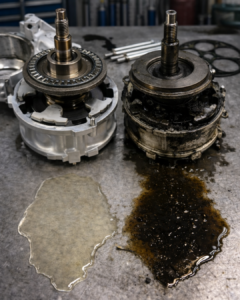

A mistake that is still far too common in workshops? Replacing the compressor while neglecting to flush the system.
When a compressor reaches the end of its service life or suffers a mechanical failure, it releases metal particles, Teflon residues, and contaminated oil into the circuit. These contaminants spread throughout the entire system.
Installing a new component in a compromised system exposes it to premature seizure. This is not a defect of the replacement part — it is a direct consequence of a contaminated circuit.
The correct procedure always includes:
The difference between a long-lasting repair and one that brings the vehicle back to the workshop after a few weeks often lies here: in proper system cleaning.
Because quality depends not only on the component installed, but also on the method used to service the system.